Imagine that you have been approved for ₹5 lakh but are unsure how much money you will actually need. You may require ₹1 lakh this month, another ₹50,000 after two months and perhaps nothing after that. Taking the entire ₹5 lakh as a conventional personal loan could mean paying interest on money sitting unused in your account.
An overdraft (OD) works differently. It provides an approved credit limit from which money can generally be withdrawn when required. Interest is typically calculated on the amount actually utilised and for the period it remains outstanding. Some banks offer personal overdraft facilities specifically on this basis.
A personal loan, meanwhile, provides a fixed amount upfront and is normally repaid through scheduled EMIs.
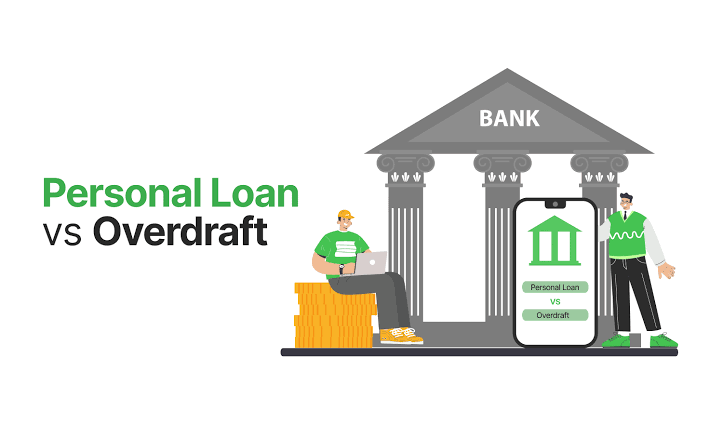
Both can solve a cash shortage, but they suit different situations. An overdraft provides flexibility, while a personal loan provides predictability.
What Is an Overdraft?
An overdraft is a revolving credit facility that allows an eligible borrower to withdraw money up to a sanctioned limit.
Suppose your bank approves an OD limit of ₹5 lakh. You do not necessarily have to use the entire ₹5 lakh immediately.
You might withdraw:
- ₹1 lakh today
- another ₹50,000 next month
- repay ₹75,000 later
- withdraw again if sufficient limit becomes available
The exact operation depends on the lender and product.
A major attraction is that interest can be charged according to the amount actually outstanding rather than simply on the entire approved limit. For example, ICICI Bank’s personal overdraft facility states that interest is charged on the amount used and for the period of utilisation.
Overdraft facilities may be secured or unsecured depending on the product.
What Is a Personal Loan?
A personal loan is generally an unsecured loan provided as a fixed amount.
Suppose you take a ₹5 lakh personal loan. The lender disburses the approved loan amount, and you repay it over an agreed tenure through regular EMIs.
The EMI normally contains both principal and interest.
Personal loans are commonly used for medical expenses, weddings, travel, home renovation, education, debt consolidation and other permitted personal requirements.
Unlike a standard OD facility, a traditional personal loan is not designed for repeated withdrawal and repayment within the same sanctioned limit.
1. How the Money Is Provided
This is the biggest difference.
With an OD, the lender provides a borrowing limit. You withdraw money from that limit when needed.
With a personal loan, you receive the sanctioned loan amount as a disbursement.
Consider someone who expects expenses of ₹4 lakh over six months but does not know exactly when each expense will occur.
An OD may be more convenient because funds can be drawn gradually.
If someone already knows that ₹4 lakh is immediately required for a specific expense, a personal loan can be simpler.
2. Interest Calculation
An OD can have a major advantage when the borrower uses only part of the sanctioned limit.
Suppose you have a ₹5 lakh OD but use only ₹1 lakh for 30 days. Under a pay-as-you-use structure, interest is based on that ₹1 lakh and the period it remains utilised.
ICICI Bank provides a similar example for its personal overdraft facility, where interest is calculated using the utilised amount and number of days.
With a conventional personal loan, interest begins on the loan amount disbursed according to its repayment structure.
Therefore, an OD can be economical when money is required irregularly.
However, this does not mean OD interest rates are always lower. Rates, processing fees and renewal charges vary by lender.
3. Repayment Flexibility
An overdraft generally provides greater flexibility.
Borrowers can often deposit surplus money into the OD account, reducing the outstanding balance and consequently reducing future interest.
Some facilities also permit the borrower to withdraw again from the available limit.
A personal loan follows a more structured repayment schedule. The borrower usually pays a fixed EMI every month until the loan is closed.
For people who prefer predictable monthly budgeting, that structure can be an advantage.
4. Which Is Easier to Manage?
A personal loan is usually easier to understand.
If the EMI is ₹12,000 for a specified number of months, the borrower knows exactly what must be paid regularly.
An OD requires more active financial management.
Because money can be withdrawn, repaid and sometimes withdrawn again, borrowers need to monitor:
- Outstanding balance
- Available limit
- Interest
- Required credits or repayments
- Renewal conditions
- Applicable charges
RBI treats overdraft accounts differently from conventional term loans for asset-classification purposes and specifies conditions under which an OD account can become “out of order.”
An OD should therefore not be treated as permanently available free money.
5. Which Is Better for Emergency Funds?
An overdraft can be particularly useful as a financial backup.
Suppose a person has a ₹3 lakh approved OD but normally keeps the utilisation at zero.
An unexpected medical expense of ₹70,000 occurs. The person can use ₹70,000, repay it after receiving income and stop paying interest once the utilised amount has been cleared according to the facility terms.
Taking a new personal loan each time a temporary shortage occurs would be less convenient.
However, keeping an OD permanently utilised can eliminate much of this advantage.
6. Which Is Better for a Large One-Time Expense?
A personal loan is generally easier to manage when the exact amount is known.
Suppose a borrower needs ₹6 lakh immediately for home renovation and wants five years to repay it.
A personal loan provides a clear amount, tenure and EMI.
An overdraft may offer unnecessary flexibility if the borrower plans to withdraw the entire limit immediately and keep it outstanding for years.
The benefit of OD is strongest when borrowing needs fluctuate.
7. Charges and Renewal
Borrowers sometimes compare only interest rates and overlook other costs.
An OD facility can involve processing or renewal charges depending on the lender. ICICI Bank’s current personal OD product, for example, lists processing and annual renewal fees in addition to interest.
Personal loans may also involve processing charges and, depending on the product and applicable rules, prepayment-related conditions. SBI, for example, publishes specific prepayment provisions for its personal-loan products.
Always compare the total expected cost, not just the headline interest rate.
8. Risk of Over-Borrowing
OD flexibility can also become its biggest weakness.
Because repaid money may become available again, some borrowers repeatedly use the facility instead of clearing their debt permanently.
A ₹3 lakh OD can gradually start feeling like an additional ₹3 lakh of income.
It is not.
Every withdrawal is debt.
A personal loan provides a more disciplined path because regular EMIs gradually reduce the outstanding principal.
For borrowers who struggle with spending control, the rigid structure of a personal loan may actually be safer.
OD vs Personal Loan: Which Is Better?
An OD may be better when:
- Your borrowing requirement changes frequently.
- You do not need the entire sanctioned amount immediately.
- You expect to repay and reuse funds.
- You want interest linked mainly to actual utilisation.
- You need a backup source for temporary cash shortages.
A personal loan may be better when:
- You know exactly how much money is required.
- The expense is a one-time requirement.
- You prefer fixed EMIs.
- You want a clear repayment end date.
- You do not need repeated access to borrowed money.
Final Thoughts
An overdraft wins on flexibility, while a personal loan wins on simplicity and predictable repayment.
If money is needed occasionally and can be repaid quickly, an OD can be efficient. If a fixed amount is required for a defined expense and will be repaid gradually, a personal loan is usually easier to manage.
Frequently Asked Questions
Q1. Can I close an overdraft before its sanctioned period ends?
Many lenders permit early closure of an overdraft after the outstanding amount and applicable dues are cleared. Charges, if any, depend on the specific product. Some products may offer closure without pre-closure charges.
Q2. Does an unused overdraft limit cost anything?
There may be no interest on an unused amount under a pay-as-you-use OD structure, but processing, renewal or other facility charges can still apply. Borrowers should check the complete fee schedule before maintaining an OD only as an emergency backup.
Q3. Can depositing extra money into an OD reduce interest?
Generally, yes, for OD products where interest depends on the outstanding utilised balance. Depositing surplus funds reduces the amount outstanding and can therefore reduce subsequent interest. The exact calculation depends on the lender’s product terms.
Q4. Is an overdraft automatically better for someone with irregular income?
Not necessarily. Flexible repayment can help people with uneven cash flow, but an OD can become difficult to control if the outstanding amount is never substantially reduced. A borrower with irregular income should maintain enough cash flow to meet the facility’s required payments and avoid the account becoming irregular.