Leh Main Market is the commercial and cultural heart of Ladakh’s capital town, sitting at one of the highest inhabited trading points in the world. In a region defined by dramatic landscapes, ancient Buddhist culture, and extreme geography, the main market of Leh serves as the point where all of it comes together in daily human activity. It is where local Ladakhi residents, migrant traders, tourists from across India, and international travellers meet over commerce, food, and the unhurried rhythm of high-altitude town life.
The market is known for pashmina and woollen products, Tibetan handicrafts, turquoise and silver jewellery, dried apricots, local spices, thangka paintings, Buddhist artefacts, trekking gear, and general daily goods. It serves both the resident population of Leh and the large seasonal tourist inflow that defines the town’s economy between May and October. Leh Main Market is located along the main bazaar road in Leh town, Ladakh Union Territory, with the pin code 194101.
History of Leh Main Market Ladakh
Leh’s history as a trading centre goes back many centuries. The town sat at the crossroads of some of Asia’s most important ancient trade routes connecting India, Tibet, Central Asia, and China. The Silk Route passed through Ladakh, and Leh functioned as a major stopover and trading post where merchants exchanged wool, spices, silk, pashmina, dried fruits, and other goods across civilisations. This centuries-old trading identity gave Leh a commercial character that predates modern market structures by a long stretch.
The main bazaar of Leh developed as a natural focal point of this trade activity over generations. Merchants from Kashmir, Tibet, Central Asia, and the plains of India passed through and many settled, giving Leh’s market its distinctly layered cultural character. The town’s role as the capital of the former Kingdom of Ladakh further cemented its position as the primary commercial hub of the entire region.
After Ladakh’s integration into modern India and the opening of the Srinagar-Leh highway, the market evolved to serve a growing resident population and an expanding tourism economy. The conversion of Ladakh into a Union Territory in 2019 brought further administrative and infrastructural attention to Leh, reinforcing its position as the region’s primary urban and commercial centre.
Location of Leh Main Market Ladakh
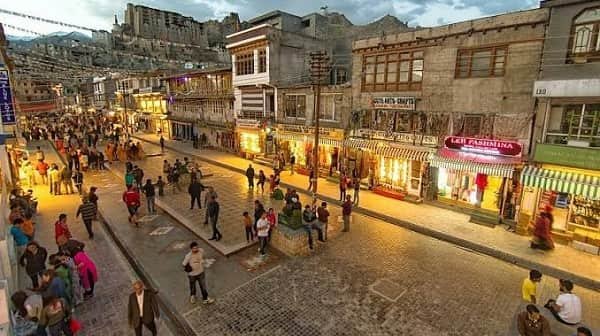
Leh Main Market runs along the central bazaar road in Leh town, set against the backdrop of the Leh Palace and the Namgyal Tsemo Monastery on the hill above. The market area is the principal commercial spine of the town and connects to the surrounding lanes, guesthouses, hotels, and institutional areas. Leh town sits at an altitude of approximately 3500 metres above sea level in the Ladakh Union Territory. The pin code for the area is 194101.
The location carries natural significance. Leh sits in the Indus Valley surrounded by the Karakoram and Himalayan ranges, and the main market sits at the centre of this geographically extraordinary town. Most of Leh’s hotels, monasteries, government offices, and tourist services are within reachable distance of the main bazaar, making it the default gathering and shopping point for everyone in the town.
Leh does not have a railway connection. Kushok Bakula Rimpochee Airport in Leh is one of the highest commercial airports in the world and connects the town to Delhi, Srinagar, Jammu, and Chandigarh by air. By road, Leh is accessible via the Srinagar-Leh Highway and the Manali-Leh Highway, both of which are open only during summer months. Within Leh town, walking is the most common way to navigate the main market area.
Shops in Leh Main Market Ladakh
Leh Main Market has a compact but remarkably varied mix of shops reflecting both the local Ladakhi economy and the demands of a strong tourism trade. The market includes pashmina and woollen shawl shops, Tibetan handicraft stores, silver and turquoise jewellery shops, thangka painting dealers, Buddhist artefact and prayer item shops, dried apricot and dry fruit vendors, local spice stalls, Ladakhi traditional dress shops, trekking and outdoor gear stores, pharmacy and medical shops, grocery and provisions stores, restaurants and cafes, and general daily needs shops.
Pashmina and woollen products are among the most purchased items. Several shops carry genuine Ladakhi and Kashmiri pashmina alongside woollen stoles, caps, gloves, and socks suited to the cold climate. Buyers are advised to verify quality and source carefully as the tourist trade has also brought in mass-produced imitations alongside genuine handmade products.
Jewellery shops specialising in turquoise, coral, and silver pieces in traditional Ladakhi and Tibetan designs are a distinctive feature of the market. These pieces range from everyday ornaments to collector-worthy antique items depending on the shop.
What Is Leh Main Market Ladakh Famous For?
Leh Main Market is most famous for pashmina products, Tibetan handicrafts, and turquoise jewellery. These three categories define the market’s tourist identity and represent the cultural and geographical specificity of Ladakh as a shopping destination.
Apart from these, the market is also known for:
- Dried apricots and apricot oil
- Thangka scroll paintings
- Buddhist prayer wheels and artefacts
- Traditional Ladakhi jewellery and dress
- Woollen caps, gloves, and socks
- Local herbal teas and spices
- Trekking and camping gear
- Singing bowls and meditation items
- Locally produced jams and preserves
- Souvenirs and decorative handicrafts
Ladakh’s geographic and cultural position at the meeting point of Tibetan, Central Asian, and Indian influences gives its market products a character that cannot be replicated elsewhere. Dried apricots from Ladakhi orchards, apricot kernel oil, and local herbal products are especially valued for their quality and authenticity. The market is useful for travellers looking for genuine regional products, cultural artefacts, and high-altitude appropriate gear.
Market Timings and Best Time to Visit
Most shops in Leh Main Market open around 9:00 AM and remain active until 8:00 PM or 9:00 PM during the tourist season from May to October. During winter months from November to April, many tourist-facing shops close entirely as the town’s visitor population drops sharply and some roads become inaccessible. Essential services, grocery shops, and pharmacy stores remain open through the year for the resident population.
The best time to visit the market is between June and September when the full range of shops is operational, the weather is pleasant, and the town is at its most active. Morning visits between 9:00 AM and 12:00 PM are comfortable and less crowded. Afternoons can get busy with tourist footfall. Acclimatisation to the high altitude is important for all visitors and strenuous activity including extended market walking should be avoided in the first day or two after arrival.
How to Reach Leh Main Market Ladakh
For most visitors, Leh is reached by air via Kushok Bakula Rimpochee Airport which has regular flights from Delhi, Srinagar, and Jammu. The airport is a short taxi ride from the main market area in Leh town. By road, the Manali-Leh Highway takes approximately two days from Manali and the Srinagar-Leh Highway takes one to two days from Srinagar, both offering dramatic mountain scenery along the way. Within Leh town, the main market is centrally located and most visitors staying in the town reach it on foot from their accommodation.
Nearby Places
Leh Main Market is surrounded by some of Ladakh’s most significant landmarks. Nearby places include Leh Palace, Namgyal Tsemo Monastery, Shanti Stupa, Jama Masjid Leh, Hall of Fame museum, Leh old town lanes, Sankar Monastery, and the Indus River valley stretching toward Hemis, Thiksey, and Shey monasteries. Most of Ladakh’s famous tourist circuits begin and end in Leh, and the main market serves as the natural base for all of them.
In short, Leh Main Market carries the weight of centuries of trade history while serving the very contemporary needs of one of India’s most visited high-altitude destinations. It is a market shaped equally by ancient Silk Route commerce and modern tourism, by Ladakhi Buddhist culture and Kashmiri trading tradition, by the extreme geography of the Himalayas and the warmth of the people who have made this remarkable place their home. For any visitor to Ladakh, time spent in the main market of Leh is time spent at the living centre of everything the region represents.